The Best AI Visibility Tools in 2026: 8 Tools Compared
Compare the best AI visibility tools for 2026 on price, AI platforms, prompts and features, from Citradar and Otterly.AI to Peec AI, Profound, Semrush and Ahrefs.
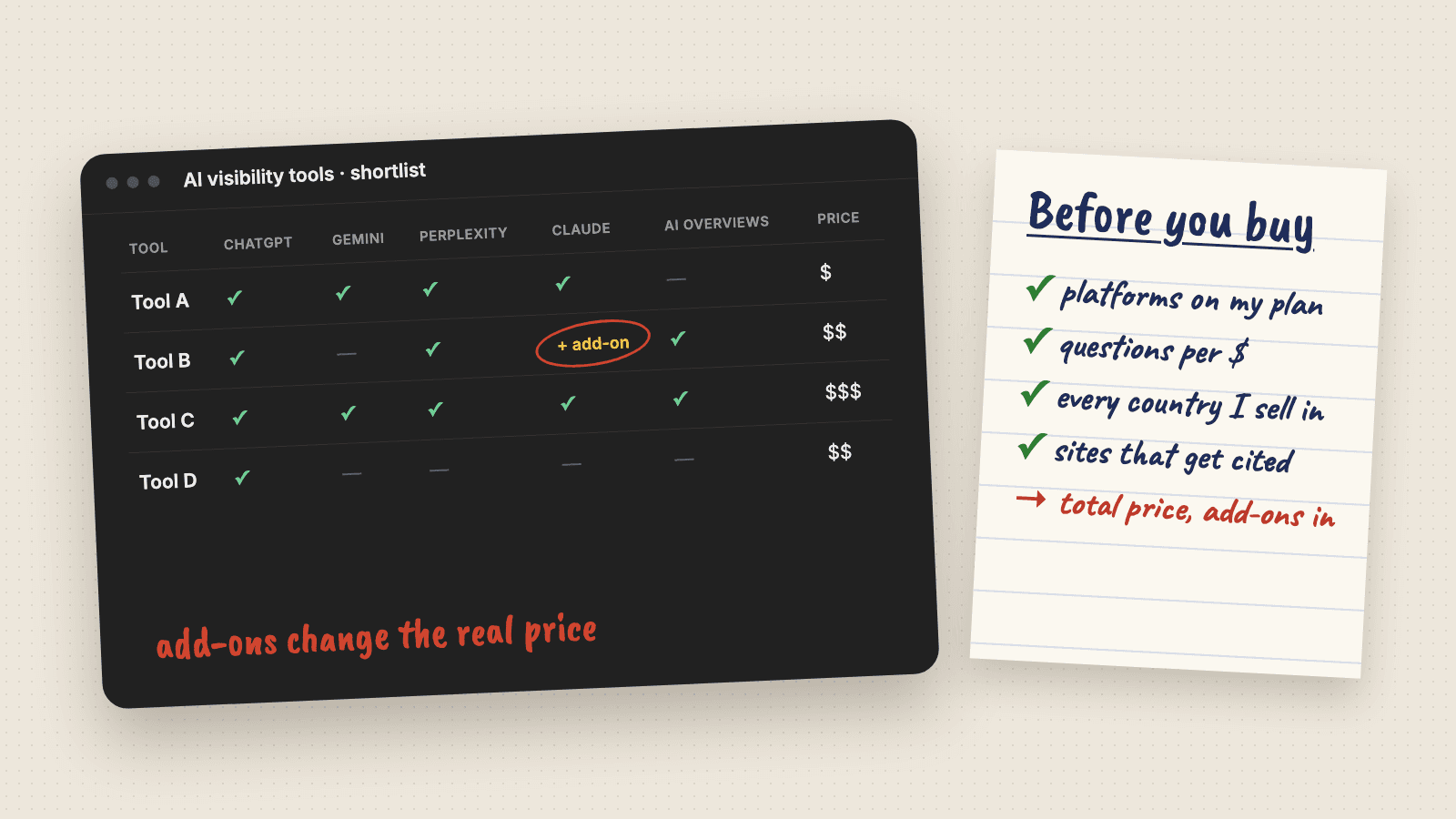
Ask ChatGPT for the best software in your category and it will give you a short list. Your buyers are asking the same question, and whether your brand makes that list now shapes who gets shortlisted. The problem is that you cannot see it. Answers change from one run to the next, differ between assistants, and never show up in your analytics.
AI visibility tools solve that by asking AI assistants your buyers' questions on a schedule and turning the answers into numbers you can track. This guide explains what these tools do, what to look for, and compares eight of them on price, AI platforms and features.
What an AI visibility tool does
An AI visibility tool works like rank tracking for AI answers. You give it the questions your buyers ask, such as "What's the best project management tool for a remote agency?", and it asks them across AI assistants every day or every week. Then it reads each answer and records:
- Mentions: whether your brand was named at all.
- Position: where you appeared in the list, compared with competitors.
- Share of voice: your mentions as a share of every brand mention.
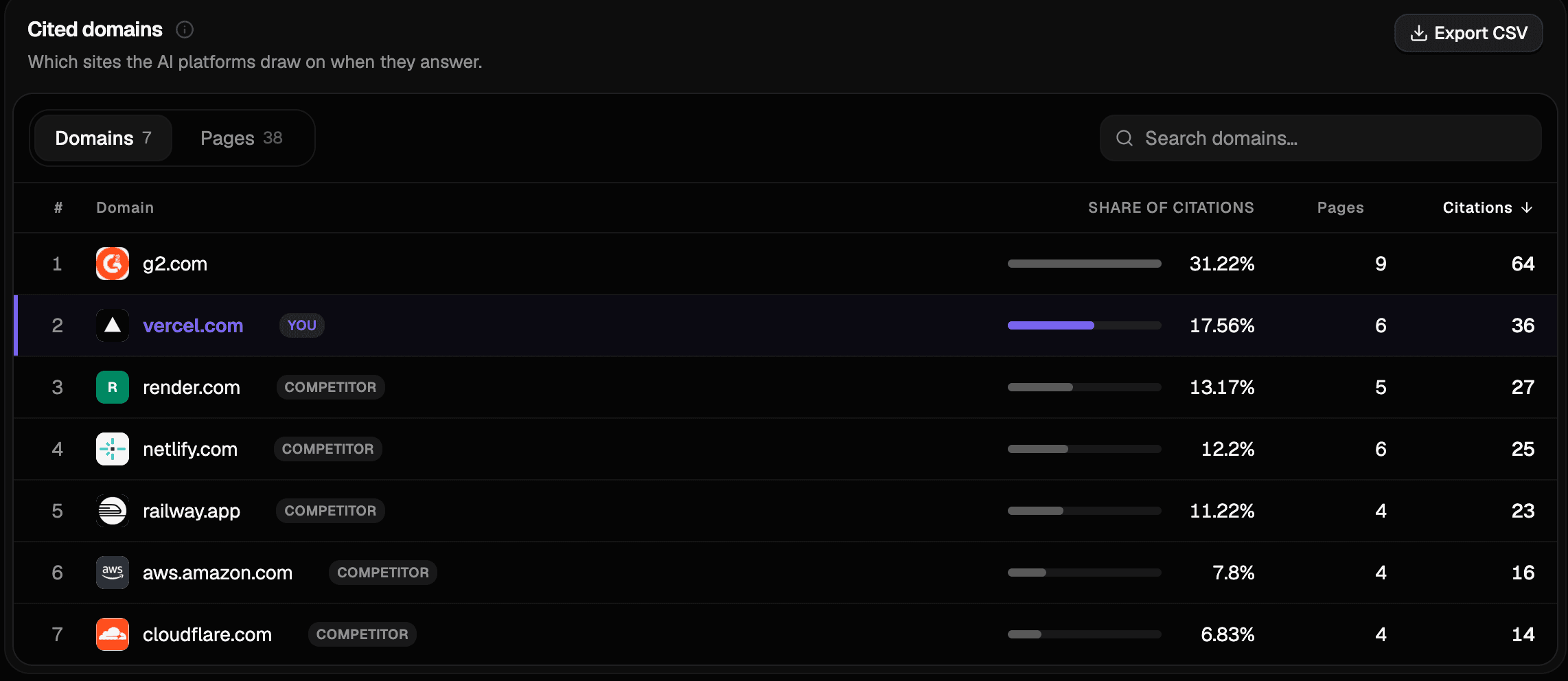
- Citations: which websites the assistant cited when it answered.
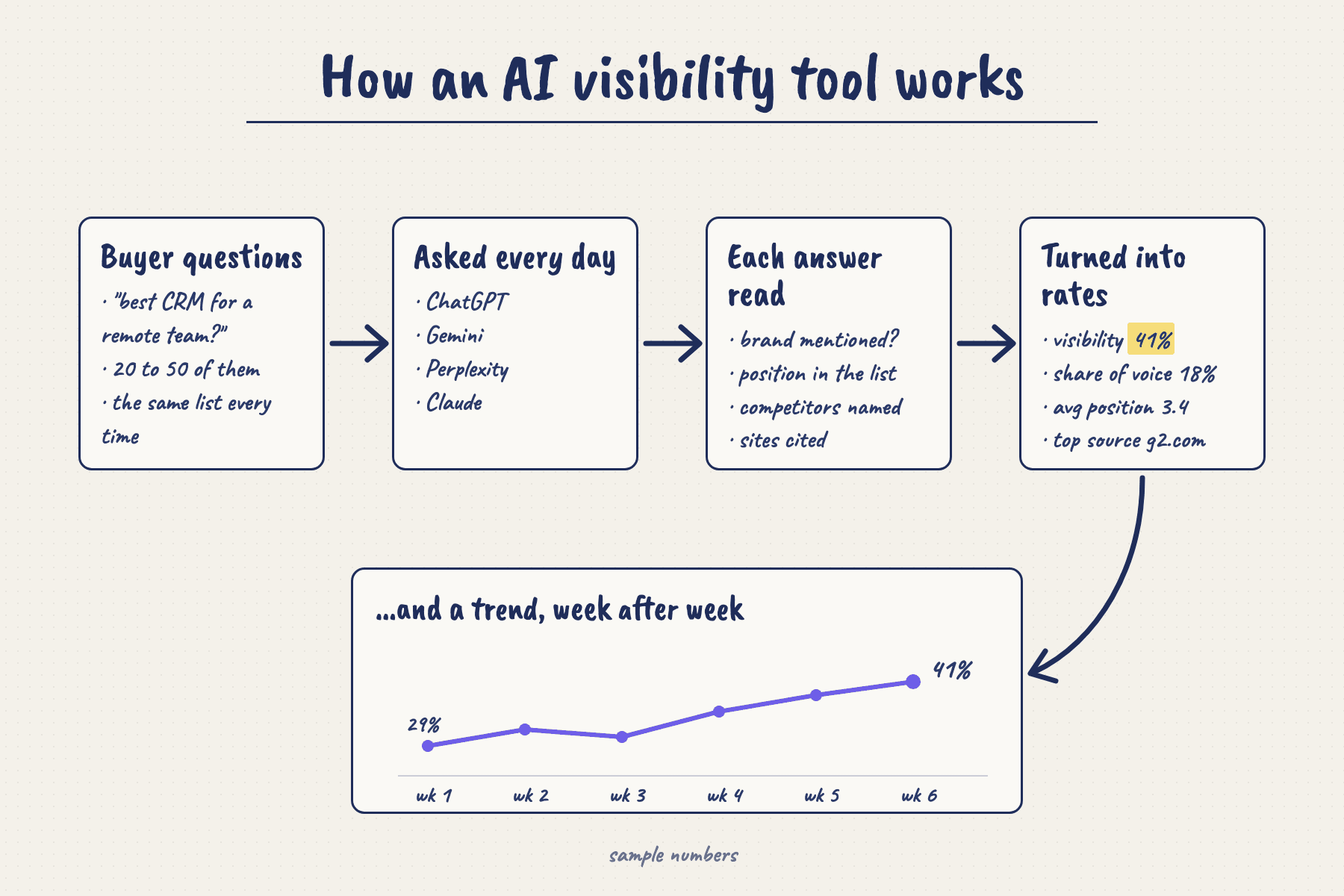
One answer tells you very little, because the same question can produce a different list tomorrow. A rate built from many answers, asked the same way over time, is what makes the number worth acting on. Our guide on how to track your brand in ChatGPT explains why, and shows how to do it by hand.
What to look for in an AI visibility tool
The tools below all track brand mentions. They differ on six things that matter more than any feature list.
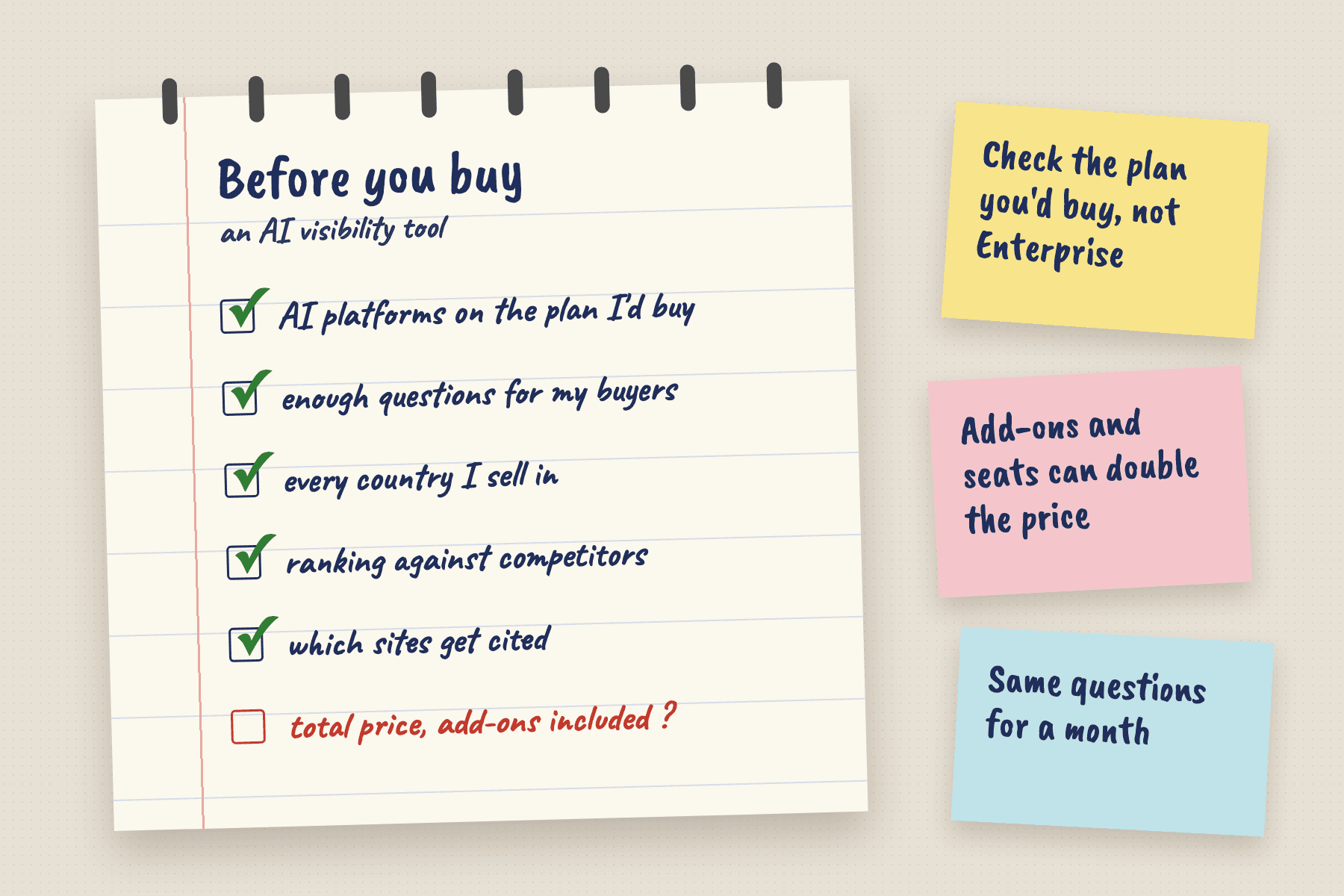
- AI platforms covered. Check which assistants are included on the plan you would actually buy, not on Enterprise. Some entry plans track one platform; others track four or more.
- Number of tracked questions. Plans are usually priced by prompts. Twenty-five well-chosen buyer questions tell you more than two hundred variations of the same one.
- Markets. If you sell in more than one country, check whether each question can be asked from each market, and whether that costs extra.
- Competitor tracking. Look for a ranking against your competitors, and ideally suggestions for competitors you are not tracking yet.
- Citation analysis. Knowing which sites AI assistants cite shows you where to get mentioned next. This is where tracking turns into a to-do list.
- Total price. Add-on platforms, extra seats and required base subscriptions can double the headline price.
The best AI visibility tools compared
Pricing below comes from each company's public pricing page, checked in September 2026. We build Citradar, so it is listed first; the other tools are described from their own public pages.
| Tool | Starting price | AI platforms on the starting plan | Prompts on the starting plan | Best for |
|---|---|---|---|---|
| Citradar | $49/month | ChatGPT, Perplexity, Gemini | 25 | The four major assistants, daily, in several markets |
| Otterly.AI | $29/month | ChatGPT, AI Overviews, Perplexity, Copilot | 15 | Small teams getting started |
| Peec AI | $95/month | 3 of your choice | 50 | SEO teams covering Google's AI surfaces |
| Profound | $99/month, billed yearly | ChatGPT | 50 | Enterprise answer-engine teams |
| Semrush | $199/month | ChatGPT, Perplexity, Gemini and more | 50 | Teams already using Semrush |
| Ahrefs Brand Radar | $129/month Ahrefs plan | AI Overviews, AI Mode, ChatGPT, Perplexity, Gemini, Copilot | 5 | Teams already using Ahrefs |
| Scrunch | $300/month, or $250 billed yearly | 7 engines | 350 | Mid-size teams that want many engines and seats |
| AthenaHQ | Free plan, then $295/month | 5 free, 11 on Starter | Credit-based | Teams that want the widest model coverage |
1. Citradar (the four major assistants, tracked daily)
Citradar asks your tracked questions every day and records every answer in full. It tracks ChatGPT, Perplexity and Gemini from $49/month for 25 questions, and adds Claude on its $99/month Growth plan for 50, so the four assistants people most often ask for recommendations are measured side by side. Scale is $199/month for 100 questions across 3 brands. Each question can be set to one of 10 countries on every plan.
Every answer is rolled up into visibility, share of voice, average position and a ranking against your competitors. Citradar suggests new competitors it finds in the answers, and its source analysis turns the sites that cite competitors but not you into a checklist. Growth and Scale add weekly reports.
Citradar does not track Google AI Overviews, AI Mode or Microsoft Copilot, and Starter and Growth cover one brand. It suits teams that want the major assistants tracked daily, in several markets, without an enterprise contract. See pricing for the full plan comparison.
2. Otterly.AI (the lowest entry price)
Otterly.AI's Lite plan is $29/month for 15 search prompts, tracking ChatGPT, Google AI Overviews, Perplexity and Microsoft Copilot, with unlimited team members. Standard is $189/month for 100 prompts, and Premium is $489/month for 400, with 15% off on annual billing and a free trial.
Gemini, Google AI Mode and Claude are paid add-ons whose price rises with the plan: Claude is $29/month on Lite and $109/month on Standard. It suits solo marketers and small teams who want to start tracking cheaply with a short list of questions.
3. Peec AI (for SEO teams that want Google's AI surfaces)
Every Peec AI self-serve plan tracks 3 models you choose from ChatGPT, Perplexity, Gemini, Google AI Mode, AI Overviews and Microsoft Copilot. Starter is $95/month for 50 prompts, Pro $245/month for 150, and Advanced $495/month for 350, with 15% off on annual billing. Claude is available on Enterprise.
Every plan includes unlimited team users, sentiment scoring, AI Shopping at product level, crawler analytics and an MCP server. It suits SEO teams that want Google's AI surfaces and deeper analytics next to ChatGPT. Our Citradar vs Peec AI comparison covers the differences in detail.
4. Profound (for enterprise answer-engine teams)
Profound's Starter plan tracks 50 prompts on ChatGPT only for $99/month billed yearly. Growth tracks 100 prompts across ChatGPT, Perplexity and Google AI Overviews for $399/month billed yearly, and Enterprise extends coverage to up to nine engines, including Claude, Gemini, Copilot and Google AI Mode.
Beyond tracking, Profound includes content-writing agents and Agent Analytics for AI crawler traffic, with API access, SSO and SOC 2 on Enterprise. It suits larger marketing teams that want Google's AI surfaces and content production in one platform. See our Citradar vs Profound comparison for a closer look.
5. Semrush (for teams already using Semrush)
Semrush includes AI prompt tracking in its SEO and AI search plans rather than as a separate product on its pricing page. Starter is $199/month with 50 prompts tracked daily, Pro+ $299/month with 100, and Advanced $549/month with 200, with up to 17% off on annual billing and a 7-day free trial. Semrush lists ChatGPT, Perplexity and Gemini among the platforms it covers.
The advantage is having AI visibility next to keyword research, backlinks and site audits in a tool your team may already pay for. It suits SEO teams that want one subscription rather than a dedicated AI visibility tool.
6. Ahrefs Brand Radar (for market-wide data)
Brand Radar needs an Ahrefs subscription. Ahrefs plans start at $129/month, and include a small number of your own tracked AI prompts: 5 on Lite, 10 on Standard and 20 on Advanced. Its AI indexes, a large database of prompts Ahrefs already tracks, are sold as add-ons from $199/month.
Brand Radar covers Google AI Overviews, AI Mode, ChatGPT, Perplexity, Gemini and Microsoft Copilot. Its strength is scale: you can see how a brand appears across millions of prompts without writing any. It suits teams already on Ahrefs that want a market-wide view, more than daily tracking of their own buyer questions.
7. Scrunch (for many engines and seats)
Scrunch's Starter plan is $300/month, or $250/month billed yearly, for 350 custom prompts, 3 user seats and 5 page audits. Growth is $500/month, or $417/month billed yearly, for 700 prompts and 5 seats. Every plan monitors ChatGPT, Claude, Gemini, Perplexity, Google AI Mode, AI Overviews and Meta AI, and Starter comes with a 7-day free trial without a credit card.
It suits mid-size marketing teams that want wide engine coverage and high prompt volumes from the first plan, and can justify the higher starting price.
8. AthenaHQ (for the widest model coverage)
AthenaHQ has a free Essential plan with 300 credits across 5 models: ChatGPT, Perplexity, Google AI Overviews, Gemini and Copilot. Its Starter plan is $295/month for 3,600 credits a month across 11 models, adding Google AI Mode, Claude, Grok, DeepSeek, Meta AI and Mistral. Enterprise is priced on request.
Because it is credit-based, how many questions you can track depends on how you use it, which makes costs harder to compare with prompt-based plans. It suits teams that need to cover many models, including ones most tools skip.
How to choose the right AI visibility tool
Start from your buyers and your budget, not from the longest feature list.
- You want the major AI assistants tracked daily on a small budget: Citradar covers ChatGPT, Perplexity and Gemini from $49/month and all four with Claude at $99/month. Otterly.AI is cheaper to start if 15 questions are enough.
- Google search drives most of your traffic: Peec AI, Scrunch and Ahrefs Brand Radar all cover Google AI Overviews and AI Mode.
- You already pay for Semrush or Ahrefs: try the AI tracking in the plan you have before buying a second tool.
- You sell in several countries: check that each question can be asked from each market on the plan you choose.
- You are an enterprise team with procurement requirements: Profound, Scrunch and AthenaHQ offer Enterprise plans with SSO and dedicated support.
Whichever you pick, keep the same set of questions for at least a month. Visibility only means something as a trend, and changing the questions resets it.
Frequently asked questions
What is an AI visibility tool?
An AI visibility tool asks AI assistants such as ChatGPT, Gemini and Perplexity the questions your buyers ask, on a schedule, and measures how often your brand is mentioned, where it ranks against competitors and which websites are cited.
How much do AI visibility tools cost?
Self-serve plans start at $29/month with Otterly.AI and $49/month with Citradar, and most mid-range plans cost between $95 and $300 a month. Profound, Peec AI, Scrunch and AthenaHQ also offer Enterprise plans priced on request.
Is there a free AI visibility tool?
AthenaHQ offers a free plan with 300 credits across 5 models. You can also check your visibility by hand, by asking ChatGPT your buyers' questions in a Temporary Chat and recording the answers, though one answer is not a reliable measure.
Which AI platforms should I track?
Start with the assistants your buyers use. ChatGPT is the most common starting point, with Gemini, Perplexity and Claude the usual additions. If Google search drives your traffic, add Google AI Overviews and AI Mode, which Peec AI, Scrunch, Ahrefs Brand Radar and AthenaHQ track.
Start with the questions your buyers ask
The right tool is the one that measures the assistants your buyers use, for the questions they actually ask, often enough to show a trend. Pick 20 to 50 of those questions, choose a tool that covers the platforms that matter to you, and measure the same questions every week. That is how AI visibility stops being a guess and becomes a number your team can move.
See where your brand appears in AI answers
Enter your domain to track brand mentions, competitor positions and the sources shaping answers across ChatGPT, Claude, Gemini and Perplexity.
