How to Appear in ChatGPT: Paid Ads vs. Organic Mentions
ChatGPT now has ads. Learn how ChatGPT ads work, who sees them, how to buy them, and how to earn organic mentions inside ChatGPT's answers.
Until this year there was only one way for a brand to show up when someone asked ChatGPT for a recommendation: be named in the answer. Now there are two. OpenAI started testing ads in ChatGPT in the United States on February 9, 2026, and has since taken them to more countries, including 31 European markets from August 24.
That gives marketing teams a real choice. You can pay for a placement next to the answer, or earn a mention inside it. They reach different people, work in different ways and fail in different ways. This guide explains how each one works, how to get started with both, and how to decide where your budget and time should go.
The two ways your brand can appear in ChatGPT
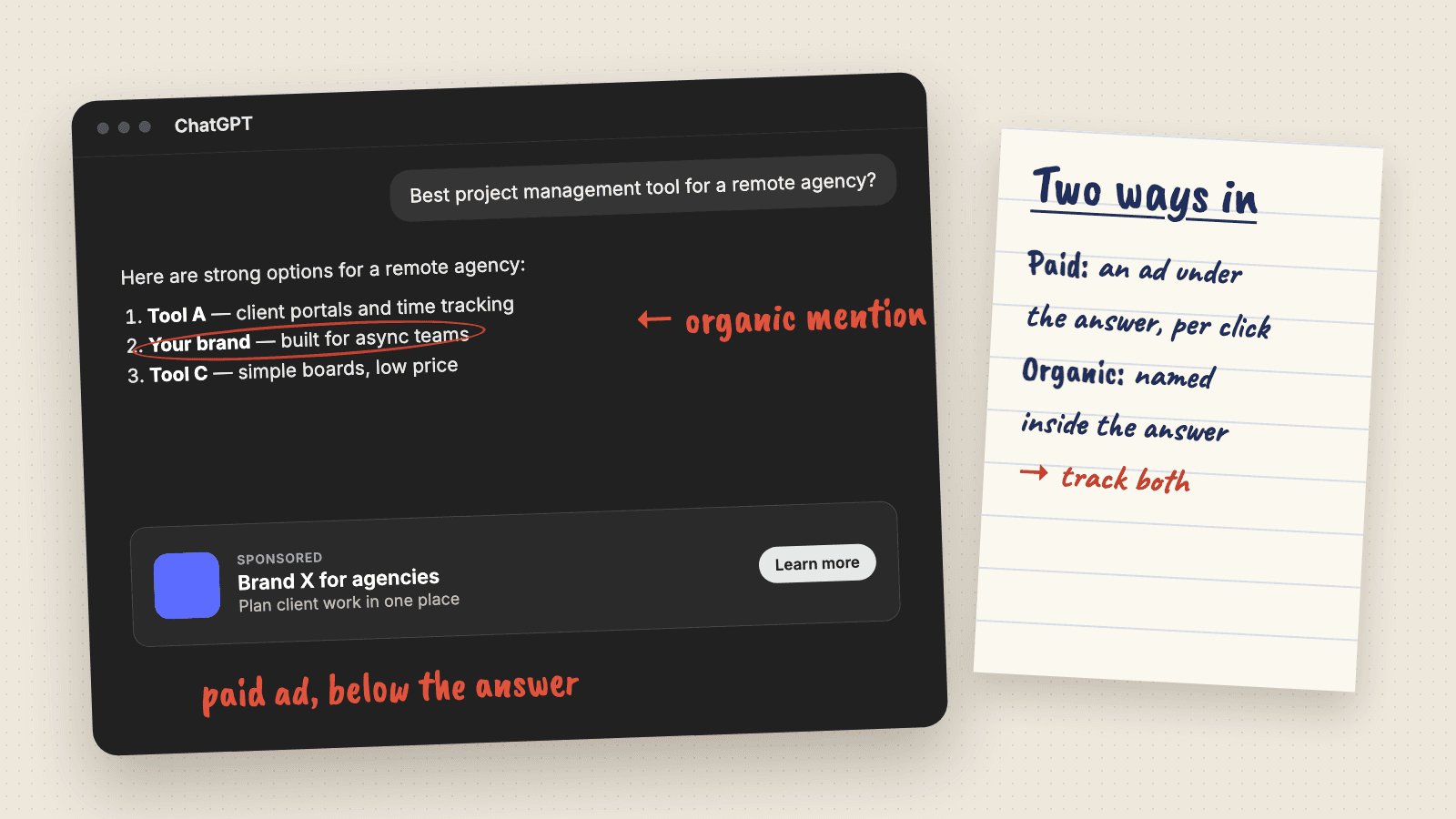
When someone asks ChatGPT "What's the best project management tool for a remote agency?", your brand can show up in two places.
- An organic mention is when ChatGPT names you in its answer, because what it knows and the pages it reads point to you. Nobody can buy this.
- A paid ad is a sponsored placement that appears below the answer, clearly labeled and separate from what ChatGPT wrote.
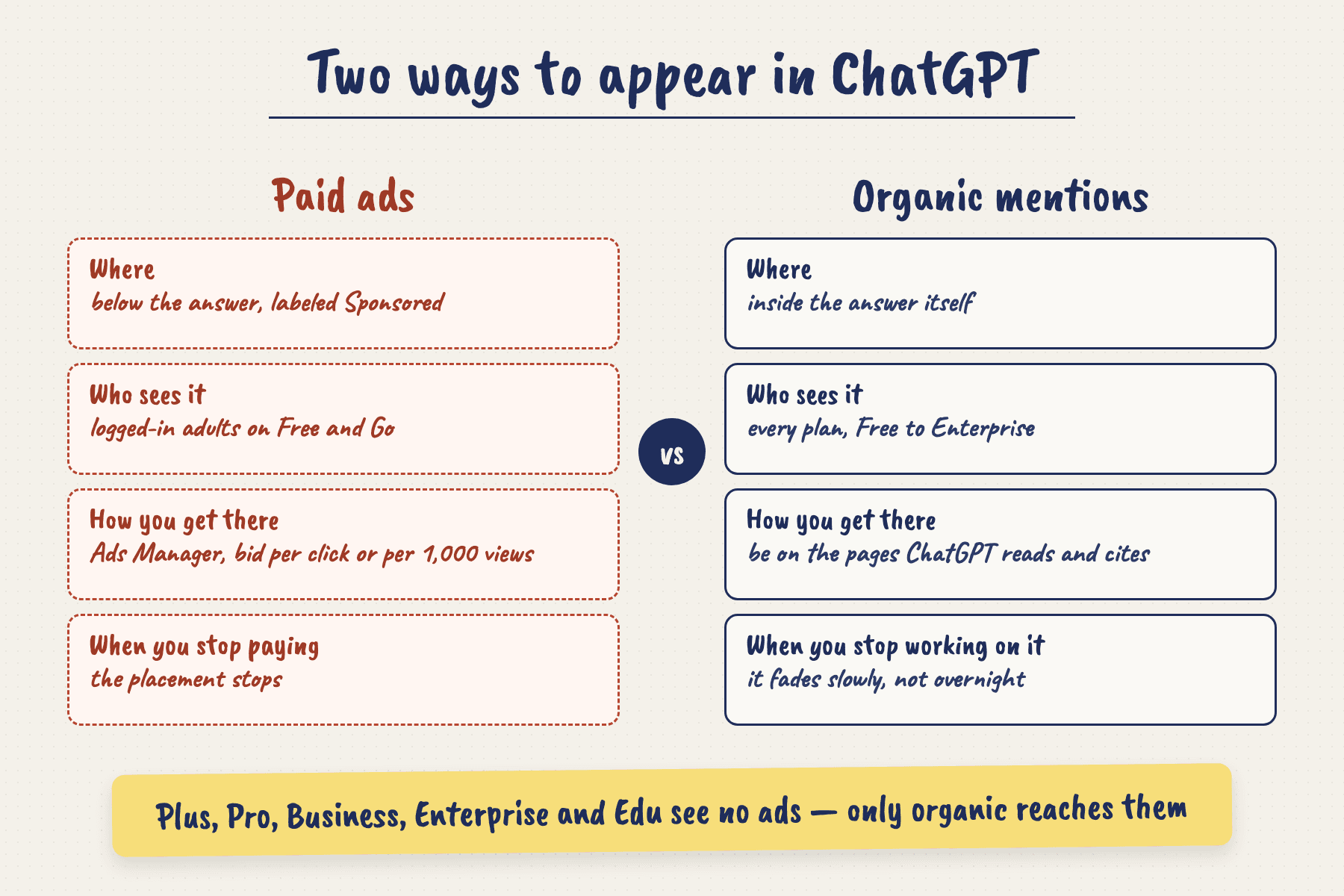
The difference that matters most is who each one reaches. Ads are shown only to some ChatGPT users. Organic mentions reach everyone who asks the question.
How ChatGPT ads work
OpenAI has published clear rules for ads, and they shape what ads can and cannot do for your brand.
Who sees them. Ads may appear for logged-in adults on the Free and Go plans. People on Plus, Pro, Business, Enterprise and Edu do not see ads, and OpenAI does not show ads to accounts it identifies as belonging to people under 18.
Where they appear. Ads appear below the end of a response, labeled as sponsored and visually separated from ChatGPT's answer. One or more ad units can appear when there is a relevant match to the conversation.
What they cannot do. OpenAI says ads do not influence ChatGPT's answers. Ads run on systems separate from the chat model, and advertisers have no ability to shape, rank or alter ChatGPT's responses. Buying ads will not get your brand named inside the answer.
Where they never appear. Ads are not eligible to appear near sensitive or regulated topics, including personal health, mental health and politics, and OpenAI does not currently allow political advertising in ChatGPT.
What advertisers get. Advertisers never receive users' chats, chat history, memories, names, email addresses, precise location or IP addresses.
For B2B brands, the first rule deserves attention. Teams that use ChatGPT through Business or Enterprise workspaces never see ads, so a campaign cannot reach a buyer who researches vendors from a work account. Organic mentions can.
How to advertise in ChatGPT
ChatGPT ads are bought through OpenAI's self-serve Ads Manager, which is in beta, or through agency partners. Availability depends on your country, so check Ads Manager for the markets open to you.
- Choose an objective. Pick Reach to optimise for impressions and pay per 1,000 impressions (CPM), or Clicks to optimise for clicks and pay per valid click (CPC).
- Set a budget. Choose a total budget for the campaign or a daily budget.
- Set a maximum bid. Bids are set per ad group. For click campaigns, OpenAI recommends starting with a maximum bid of $3 to $5 per click, and Ads Manager can show whether a bid is likely to be competitive.
- Create your ads. Ads are matched to the context of a conversation rather than to exact keywords, so write for the problem your buyer is describing.
Ads are then chosen in a relevance-weighted, second-price auction. Relevance counts alongside your bid, which means a well-matched ad can win against a higher but less relevant one.
How to get mentioned organically in ChatGPT
Organic mentions cannot be bought, but they can be earned. ChatGPT names brands that are well represented in what it already knows and in the pages it reads when it searches the web.
Make sure ChatGPT can reach your site
OpenAI's OAI-SearchBot is the crawler used to surface websites in ChatGPT search, and sites must allow it in robots.txt to appear there. Blocking GPTBot only opts your content out of model training, not out of search. Check your robots.txt before anything else.
Be on the pages ChatGPT reads
When ChatGPT answers a recommendation question, it often cites review sites, "best tools" articles, community threads and comparison pages. If those pages name your competitors and not you, ChatGPT has little reason to mention you.
Start by finding out which sites are cited for the questions in your category. Tracking a fixed set of buyer questions over time shows you exactly that, including the sites that cite your competitors but not you. That list is what our own tool, Citradar, surfaces in its source analysis.
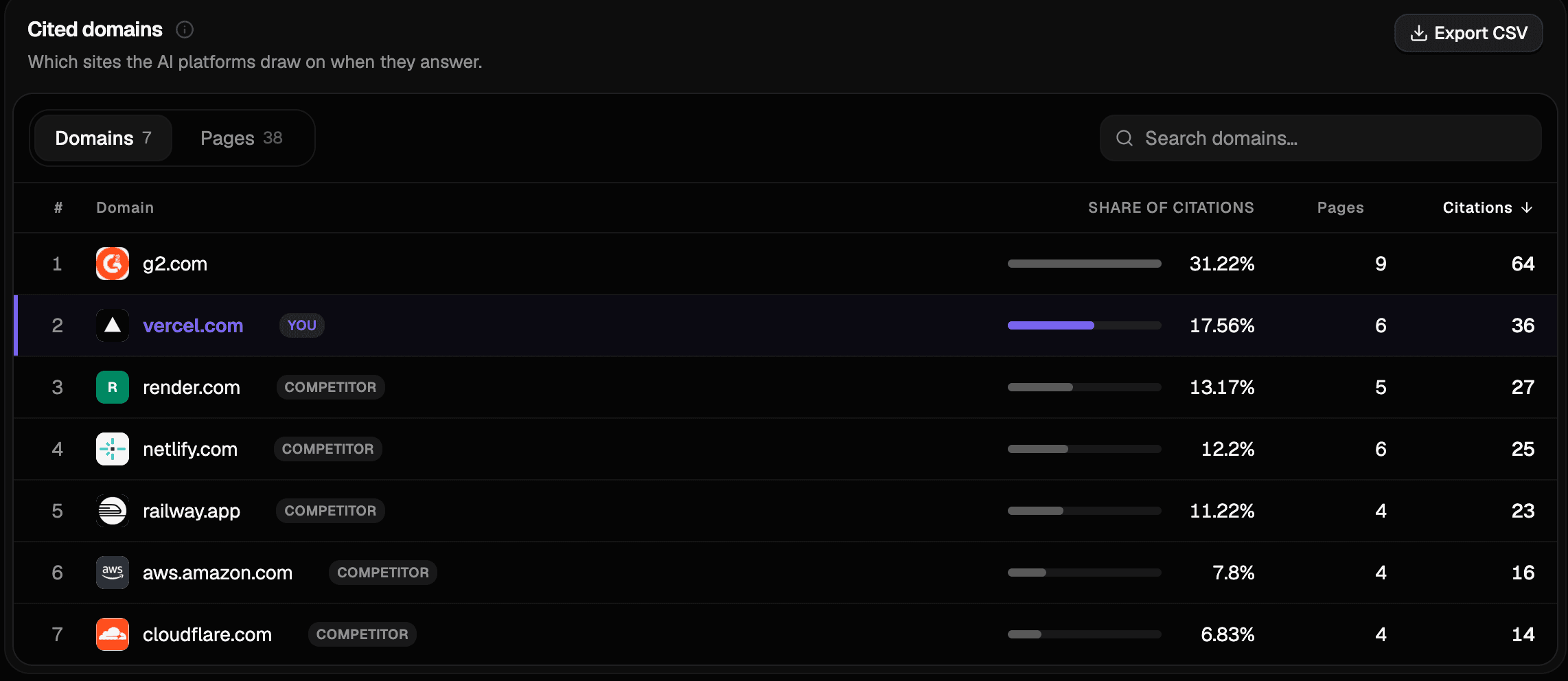
Then work through that list. Keep review profiles complete and current, ask to be added to relevant "best tools" articles, and publish comparisons that other sites will want to reference.
Make your own pages easy to quote
Write pages that state plainly what you do, who it is for and what it costs. Clear plan names, real prices, specific use cases and honest comparisons give ChatGPT facts it can repeat. Outdated or vague pages give it nothing, or worse, the wrong answer.
Describe your brand the same way everywhere
ChatGPT's picture of your company comes from many places at once: your website, review profiles, directories, social profiles and articles that mention you. When they disagree about what you do or who you serve, that picture blurs. Use the same one-sentence description, category and key facts on your site, your LinkedIn page, your review profiles and your directory listings, and fix the old ones you find.
Keep your key pages current
Answers that draw on the web repeat whatever your pages say, including a price you changed six months ago. Put a visible "last updated" date on pricing, comparison and guide pages, and review them whenever your product, pricing or competitors change.
Take part where your buyers talk
Community threads, professional posts and reviews are among the sources AI assistants read, and they are hard to fake. Answer questions in the communities your buyers use, share what you learn on LinkedIn, and ask happy customers to leave reviews. The goal is not links, but a public record of real people describing your product.
If you sell products, submit your catalog
OpenAI says product results in ChatGPT are organic and unsponsored, ranked on relevance to the user. When several merchants sell the same item, ChatGPT considers factors such as availability, price, quality and whether the merchant is the maker or primary seller. Merchants can share structured product data with ChatGPT through OpenAI's Agentic Commerce Protocol.
Paid or organic: which should you invest in?
| Paid ads | Organic mentions | |
|---|---|---|
| Where it appears | Below the answer, labeled sponsored | Inside the answer |
| Who sees it | Logged-in adults on Free and Go | Everyone who asks, on every plan |
| How fast it works | As soon as a campaign is live | Weeks to months |
| What it costs | Media spend, per click or per 1,000 impressions | Content, PR and time |
| When you stop | The placement stops | It fades gradually |
| Can you buy it | Yes | No |
Most brands will end up doing both, but the balance depends on who you sell to.
- Sell to consumers or small businesses? Ads can reach a large share of your buyers on Free and Go. Test a small campaign while you build organic presence.
- Sell to larger companies? Many of your buyers will use ChatGPT through work plans that show no ads. Organic mentions should come first.
- Launching something new? Ads can put you in front of buyers immediately, while organic mentions take time to build.
- Already mentioned often? Ads can protect the questions where competitors outrank you, but check your organic position first so you are not paying for attention you already have.
How to measure your presence in ChatGPT
Ads come with their own reporting in Ads Manager. Organic mentions do not: there is no dashboard that tells you how often ChatGPT names your brand, and a single check is misleading because answers change from one run to the next.
To measure organic presence, track a fixed set of buyer questions over time and record whether you are mentioned, where you appear against competitors and which sites are cited. You can do this by hand with a spreadsheet, as our guide on how to track your brand in ChatGPT explains, or with an AI visibility tool. We build Citradar, which tracks these questions every day across ChatGPT, Claude, Gemini and Perplexity. Our comparison of the best AI visibility tools covers the other options.
Frequently asked questions
Do ChatGPT ads affect ChatGPT's answers?
No. OpenAI says ads run on systems separate from the chat model, and advertisers cannot shape, rank or alter ChatGPT's responses. Ads appear below the answer and are labeled as sponsored.
Who sees ads in ChatGPT?
Logged-in adults on the Free and Go plans. OpenAI does not show ads on Plus, Pro, Business, Enterprise or Edu, or to accounts it identifies as belonging to people under 18.
How much do ChatGPT ads cost?
Advertisers bid in an auction and pay per click or per 1,000 impressions, with a daily or total campaign budget. For click campaigns, OpenAI recommends starting with a maximum bid of $3 to $5 per click.
Can I pay to be recommended inside ChatGPT's answer?
No. Ads appear separately below the response, and OpenAI says advertisers cannot shape or rank ChatGPT's answers. To be named inside the answer, your brand needs to appear in what ChatGPT knows and in the sources it reads and cites.
Paid gets you seen, organic gets you chosen
ChatGPT ads are a fast, measurable way to put your brand next to the questions your buyers ask, for the people who see them. Organic mentions are slower to earn, but they appear inside the answer itself and reach every ChatGPT user, including the business buyers ads cannot reach. Start by finding out where you stand organically today, then decide how much paid placement you need on top.
See where your brand appears in AI answers
Enter your domain to track brand mentions, competitor positions and the sources shaping answers across ChatGPT, Claude, Gemini and Perplexity.
